

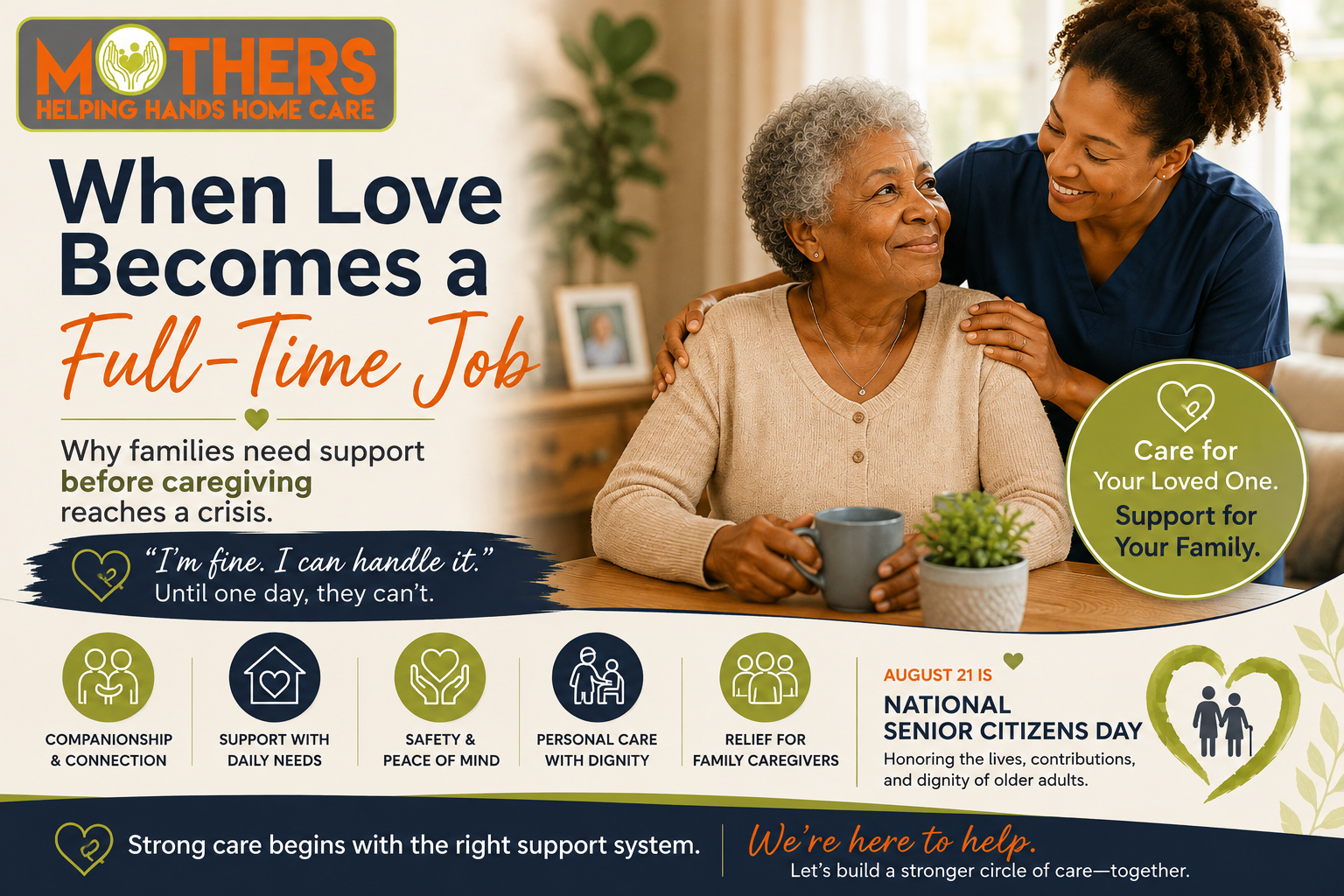
“I’m fine. I can handle it.”
Family caregivers say it every day.
A daughter checks on her mother after work. A spouse begins helping with daily routines. A son manages appointments, meals, and medications.
At first, caregiving may take only a few hours each week.
Then the needs grow.
More supervision is required. Daily tasks become harder. Memory begins to change. One family member slowly becomes responsible for almost everything.
Before long, caregiving can feel like another full-time job.
And often, families do not ask for help until they are exhausted.
Caring for Someone You Love Should Not Mean Doing Everything Alone
Family caregiving usually begins with love.
You want your parent, spouse, grandparent, or loved one to feel safe, respected, and comfortable. You may also want them to remain at home for as long as possible.
But helping someone age at home does not mean one person has to carry every responsibility.
Caregiving can affect a person’s physical health, emotional well-being, relationships, work, and daily life.
That is why support matters for both the person receiving care and the person providing it.
August Is a Good Time to Talk About Aging With Dignity
August 21 is National Senior Citizens Day, a time to honor older adults and recognize their contributions to our families and communities.
Aging with dignity means more than remaining in a familiar home.
It means having:
- Respect and meaningful choices.
- Support with daily needs.
- Companionship and connection.
- Safe routines.
- Help that promotes as much independence as possible.
- A support system for the family caregiver, too.
When Might Your Family Need More Help?
Home care needs often develop gradually.
You may notice that your loved one is:
- Struggling with everyday routines.
- Becoming more isolated.
- Needing more help with personal care.
- Forgetting meals or important tasks.
- Requiring more supervision.
- Becoming less steady or safe at home.
- Experiencing memory or cognitive changes.
- Relying heavily on one family caregiver.
But sometimes the strongest warning sign is the caregiver.
You may feel constantly tired, overwhelmed, anxious, or unable to keep up with your own responsibilities.
Needing help does not mean you care less.
It may simply mean the situation has grown beyond what one person can reasonably manage alone.
Home Care Does Not Replace Family
One of the biggest concerns families have is that bringing in home care means stepping away from their loved one.
It does not.
Sometimes support allows family members to be family again.
A daughter can enjoy a conversation with Mom instead of spending the entire visit completing tasks.
A spouse can share a quiet meal instead of managing every care need.
A son can attend an important family event knowing Dad has support at home.
Home care can create breathing room while helping loved ones remain safe, connected, and supported.
Do Not Wait for a Crisis
Many families begin looking for help after a fall, hospitalization, major change in memory, or severe caregiver exhaustion.
By then, decisions are being made under pressure.
Starting the conversation earlier can help families prepare.
Ask yourself:
What does our loved one want?
Include them in decisions whenever possible. Talk about routines, preferences, independence, and what matters most to them.
What can our family realistically provide?
Consider work, children, distance, health, finances, and other responsibilities.
Where are the gaps?
Think about companionship, supervision, personal care, daily routines, and caregiver relief.
What is our backup plan?
Know who can step in if the primary caregiver becomes unavailable.
When will we ask for help?
Do not wait until exhaustion becomes the requirement.
MHH Homecare: Supporting the Whole Family
At MHH Homecare, we understand that inviting someone into your home to support a loved one is a personal decision.
Families are not simply looking for someone to complete tasks.
They want care that respects the person behind those tasks—their routines, history, preferences, independence, and dignity.
Our goal is to help families create a stronger circle of care so their loved ones can remain supported at home while family caregivers receive some much-needed relief.
Give Your Family Permission to Receive Support
If your family has been saying, “We need to figure something out,” that may be the sign to begin the conversation.
Look at what is working.
Identify what is becoming difficult.
Listen to your loved one’s wishes.
And consider where additional support could make life safer, calmer, and more manageable.
National Senior Citizens Day reminds us to honor older adults not only with words, but through the quality of care and support we provide.
At MHH Homecare, we believe caregiving should never depend on one person doing everything.
Strong care begins with the right support system.
If your family is exploring home care for an aging loved one, MHH Homecare is here to help you take the next step.